Audiophile Productions Distribution
Emotions (High Resolution Audio)
EMOTIONS - 029 Hi-Res Audio- Classic
Emotions - aa.vv
14 tracce complete
SUPER AUDIO CD SAMPLER
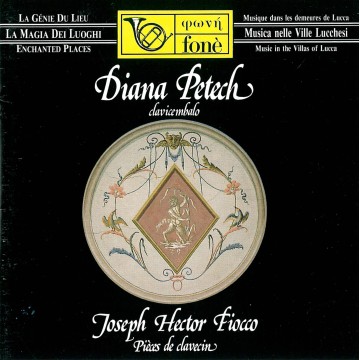
Diana Petech – clavicembalo
Joseph Hector Fiocco
TRACKLIST
DIANA PETECH
After studying the piano, she turned to antique keyboard repertoire. She studied the organ under James Edwardk Goettsche and the harpsichord under Flaminia Nardi, Scott Ross, Bob Van Asperen, Gustav Leonhardt and Kenneth Gilbert in important italian and foreign musical establishments such as the Chigiana Accademy and the Gimar de Saintes (France). To crown her achievements, she won a diploma with commendation at The Royal College of music, London.
In 1979, she commenced concert performances which, a year later, took her to France for the Sociéte de Musique Ancienne de Nice; holding concerts and courses of interpretation for them. In 1981 she was nominated an honorary member of said institution.
In 1981 she carried out a tournée in Japan with recitals at Tokyo and Kyoto and made a recording for the Japanese Radio. She took part in numerous concerts as Soloist or "Continuist" in Chamber Music groups in Italy, France, Switzerland and Belgium. She undertakes musicological research and has been responsible for the edition as critic of the integral of the "Piéces de Clavicin" by Joseph Hector Fiocco for the publishers Heugel of Paris. The volume is in preparation in the "Le pupitre" collection.
She is presently engaged in editing a glossary of vocal music by the same author which is still partially unpublished. She is writer and publisher and has long collaborated with hi-fi and music magazines; has realized a series of broadcasts for the RAI; currently signs the column "Baroccherie" on "Audioreview" and realizes specialist musical programmes for the Swiss italian language Radio.
With a recording on CD of "Pièces de Clavecin" by J.H. Fiocco, she commenced collaboration with the recording company Foné.
Joseph Hector Fiocco
Joseph Hector Fiocco was born at Brussels on the 20th. January 1703. His father, Pietro Antonio, was Veneto by birth and upbringing. He emigrated to Holland in 1681 where he indulged in various activities all having a connection with music such as the commerce of harpsicords and theatrical impresario. He was, amongst other things, the founder and the first director of the "del Quai au Foin" Theatre; still in existence under the name of "Théatre de la Monnaie". He also gained fame as a composer in a musical ambient with a prevalent french veneer, but which greatly appreciated italian musicians, to such a degree that in 1706, he obtained the title of Court Choir Master. On his death, said title was inherited by his eldest son Jean Joseph (1714). Joseph Hector, one of eleven sons from Pietro Antonio's second marriage, developed as a musician under the guidance first of his father and then his stepbrother. Already in 1728, he was appointed Assistant Choir Master at Court (Judging from what remains of his music, said title was not only due to family connections but for real professional merit).
He remained there until 1731, in which year he won a competition for the post of Choir Master at Antwerp Cathedral. The post carried less prestige but was more interesting and more remunerative and Joseph Hector transferred to Antwerp with his wife, Marie Caroline Dujardin and their four-year-old daughter.
His contract, in the new position, stipulated the composition and execution on the occasions of High Mass and Motét and various religious festivities; the complete organization of two Boys Choirs including the furnishing of victuals and lodging (The contract is most precise over this point); undertake to educate them with lessons of latin, singing, organ and harpsichord and violin. He was to organize them to give the trials and execution requested at services in the cathedral.
In March 1737, Fiocco resigned and returned to Brussels to take up the post of Choir Master at the College-Church of Sainte-Gudule in the centre of the city, where he continued to produce sacred music, also of notable value.
His sudden death on the 22nd. June 1741 when he was 38 years old, interrupted a period of great artistic fecundity.
I Pièces de Clavecin di Joseph Hector
The "Pièces de Clavecin" by Joseph Hector Fiocco were published at Brussels in a stamp realized by Jean-Laurent Krafft. Of this edition, four examples remain: one is at London, one is at Prague and two are at the National Library of Paris. With the latter I realized a new edition of the work for the collection "Le Pupitre" of the publishers Heugel of Paris. Obviously, the present recording is based on it.
A previous "Modern" edition was edited by Joseph Wathelet in 1937 at Antwerp and republished in 1955 in the series "Monumenta" Musicae Belgicae". It was not very correct and inevitably aged in editorial criteria. Hence the idea of the necessity of a new edition bearing philologic criteria and of the relative new gramophone version.
The opera appeared, as I said, at Brussels in 1730, whit a dedication to the Prince of Aremberg, to whose daughter, Fiocco gave harpsichord lessons. It consists of two suites, each of twelve pieces.
The first suite follows a very liberal scheme, whilst the second reenters in the traditional one of the french Suite with its dashing succession of Allemande, Courante, Sarabande, Gigue, Gavotte and Menuets interposed with other dances or characterial pieces with fantasy titles not always appropriate. An example for all: the Rondeau "L'Agitée" sweetly sways in 12/8 for the first three couplets and the final Double (Elaborated version) of the Rondeau itself, in semicrome, is not sufficient to constitute a piece that is indeed "Agitato".
The first Suite terminates in a really true italian Sonata in four movements: Allegro, Adagio, Andante, Vivace: an autonomous musical unity that can be played even seperatly from the rest of the Suite.
Here the italian origin of Fiocco is revealed in all clarity and in full stylistic autonomy. The remainder of the collection oscillates between the french style and a curious mixture of italian style with details of scripture and embellishment "A la française". Hence Fiocco's music realizes a certain synthesis between the two characters, as an ideal reply to those between the end of 1600 and the first half of 1700 who claimed a pretended superiority of this or that national school as the reason for a real and true war with ferocious liable publications, exchanges of insults and the burning of portraits on the public squares of Paris.
"Le Goûts réunis" so to speak. with this title already six years before, François Cuoperin published his second collection of concerts in which this synthesis was amply experimented. It may be that Fiocco was aware of same, but his sources and his influences can be more clearly traced back elsewhere. in Händel for example. who was another who was used to embodying in his most rigorous french style pieces for harpsichord, passages of clear italian melodic impression. The synthesis, therefore, was in the aria. For Fiocco, belgian born and resident but with italian blood and upbringing, it was an absoluteyl natural form of expression. The collection of Pièces de Clavecin offers passages of discontinuous quality, with pieces of honest artisanship, both those of a more common nature and those of great lyricism and real and true opera of genius.
At the time of publishing the collection, Fiocco was 27 years old. His sacred music in later years shows a continuous evolution and maturity towards an ever greater personal and intense style. It is a pity that destiny did not give him time to continue along the way opened up by this first and unique - collection of Pièces de Clavecin.
Diana Petech
Diana Petech – clavicembalo
Joseph Hector Fiocco
14 tracce complete
SUPER AUDIO CD SAMPLER
Giuseppe Mariotti piano
M. Conti, P. Pollastri, G. Riccucci, P. Carlini, P. Faggi
DUO HAYASHI
Eduard Grieg, Sonate für Klavier und Violoncello opus 36
Bohuslav Martinu, Variations sur un thème de Rossini pour Violoncelle et Piano.
J. S. Bach - N. Paganini - J. Massenet - C. Bach
Uto Ughi: violinista e direttore
Auditorium Parco della Musica Sala Santa Cecilia
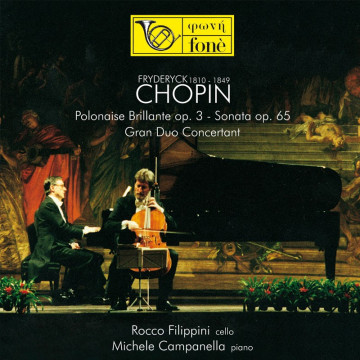
Rocco Filippini cello
Michele Campanella piano
Tube Processed Analog Master
"Grazie per essere stato parte del mio sogno"
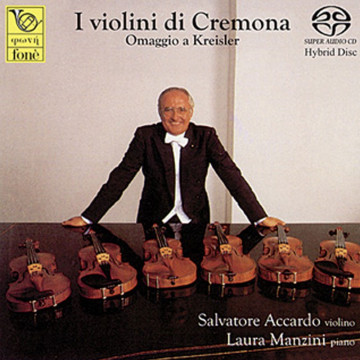
Salvatore Accardo: violino, Laura Manzini: piano
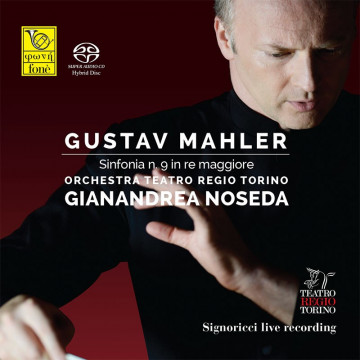
GUSTAV MAHLER
Sinfonia n. 9 in re maggiore (1909-1911)
ORCHESTRA TEATRO REGIO TORINO
GIANANDREA NOSEDA
Concerto realizzato nell’ambito del Progetto Mahler
Hi-Resolution Audio
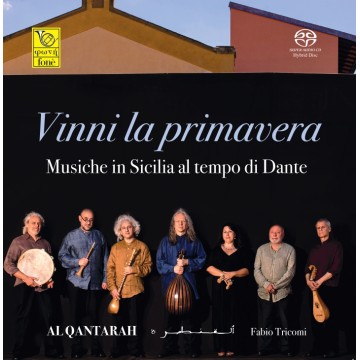
Al Qantarah F. Tricomi
Tube Processed Analog Master / natural sound recording / HiFi Reference
Al Qantarah: voci e strumenti
Fabio Accurso ud, daf, voce
Roberto Bolelli voce, scattagnetti
Farzaneh Joorabchi voce, setar
Nico Staiti tammureddu, riqq, daf
Donato Sansone friscalettu, synphonia, daf, voce
Faisal Taher voce
Fabio Tricomi viella, lira, tar, ud, friscalettu, flauto da tamburo,zarb, tammureddu, daf, marranzanu, voce