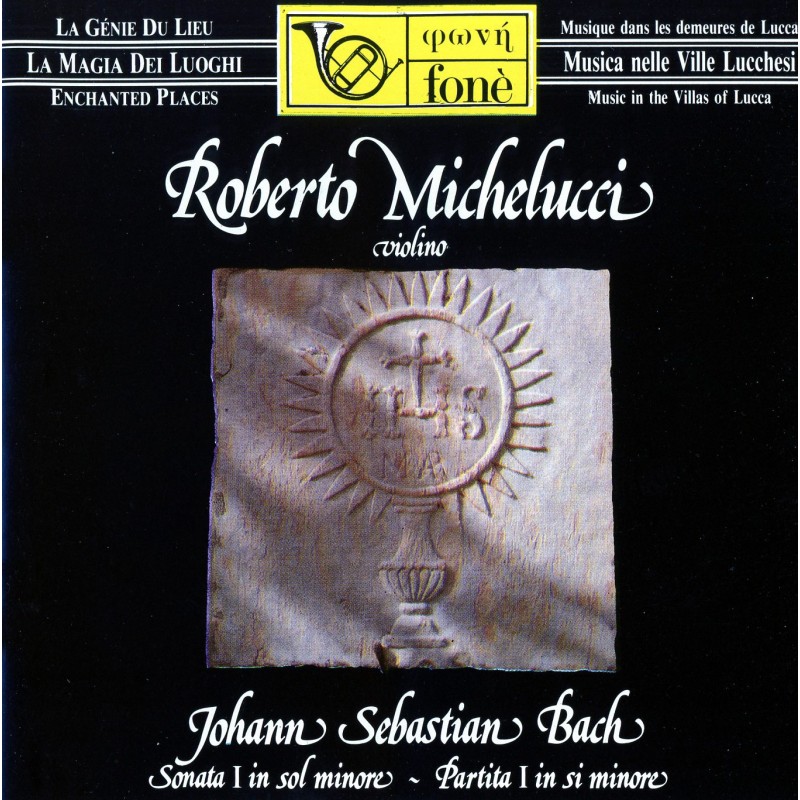
JOHANN SEBASTIAN BACH (1685-1750)
Sonata I per violino solo in sol minore BWV 1001
Adagio (4’35”)
Fuga allegro (5’39”)
Siciliana (3’15”)
Presto (3’42”)
JOHANN SEBASTIAN BACH (1685-1750)
Partita I per violino solo in si minore BWV 1002
Allemanda (6’24”)
Double (2’36”)
Corrente (3’25”)
Double presto (3’40”)
Sarabande (4’03”)
Double (2’05”)
Tempo di borea (3’44”)
Double (3’11”)
Durata: 47’00”
Roberto Michelucci is well known all over the world. Many of his best interpretations are recorded on Philips Lps with which he has won some of the highest awards. He often takes part in International Festivals and was the first Italian violinist to he invited in 1967 and 1968 by the Salzburger Festspiele to perform two Mozart Concertos. K.V. 219 and K.V. 211. The first concert was filmed by the Austrian television and later transmitted by all the European televisions except Italy. His repertoire includes music from the baroque period to the modern. He presented L. Dallapiccola's two "Tartiniana" for violin and orchestra for the first time in Israel; the first performance of Busoni's violin concerto with the Orchestre Suisse Romande in Geneva; for the first time in Florence at the "Maggio Musicale Fiorentino" the following concertos: Prokofieff Op. 19, Schumann D minor, Mendelssohn D minor. High levelled critics like F. Abbiati (Milan), M. Mila (Turin), B. Gavoty (Paris), E. Moser (Lausanne). E. Muller-Moore (Geneva), J. Hawranek (Salzburg), H. Boehm (Jerusalem), C. Wilson (Edinburgh) have expressed their admiration for him. His records have won the following awards: "Grand Prix du Disque" for three years in Paris "Prix de la Critique Francaise" Paris "Golden Record" Tokio. He often takes part in Juries for international competitions. Now he is recording for Fone, concluding the six Bach-Solo Sonatas and Partitas.
Johann Sebastian Bach (Eisenach 1685 - Lipsia 1750)
With this record Foné is inaugurating a series of the complete recordings of the Sonatas and Partitas for Solo Violin by Johann Sebastian Bach interpreted by the violinist Roberto Michelucci. Even if much of Bach's chamber music has been irredeemably lost making it impossible to follow the entire evolutionary arch of his style, the surviving works, nevertheless, give us an exact measure of the level of perfection that Bach reached in this musical genre. As do his compositions intended for other solo instruments, his Sonatas and Partitas for Solo Violin also attain peaks which will be difficult to superceed. At the end of the Seventeenth Century polyphonic writing for violin in Germany had already reached a high degree of accomplishment. According to contemporary witnesses, among whom Mattheson was a creditable musician in his own right, many German violinists distinguished themselves far and wide by way of the polyphonic character of their performances. Nikolaus Bruhns sat at the organ realizing, with the pedals, harmonic passages while simultaneously playing them on the violin. Another respected violinist, Nikolaus Struck, astounded Corelli during a stay in Rome in 1686 by playing double stops on the violin. Corelli, both surprised and amused, is said to have exclaimed: "I am called Archangel (Arcangelo), but you should be called Archdevil!". Given the above circumstances it is no wonder that Bach, in his works for solo violin, achieved a completeness of form that we still admire today. Bach began studying violin when he was young. When he left college at Lüneburg and moved to Weimar, he became much respected as a violinist in the court orchestra. While having a perfect mastery of the technique of the other string instruments, Bach preferred viola, because, as he said, it seemed to be at the centre of the performance and hearing all the other parts above and below his, he was better able to appreciate the fascination of polyphony. The three Sonatas and three Paribas for Solo Violin BWV 1001 - 1006 are preserved in an autograph, dated 1720, which itself is a graphic masterpiece. We cannot be certain about the date of composition. The Sonatas correspond to the form of church sonatas in four movements, two slow alternating with two Prestos. The first two movements have the dialectic relationship of Prelude and Fugue, the third is always in arioso style, while the final movement has the characteristics of a lively toccata. Structurally, the Sonatas are an expression of the purest polyphony, even with four voices at times. The Prelude of the first Sonata for Solo Violin in G minor is an Adagio cantabilewhich freely, with rich figurations, introduces the Fugue based on a theme of one bar only and contrapuntally elaborated by exploiting the polyphonic possibilities of the solo violin. The third movement, Siciliana, is constructed on a simple melody and develops through light rhythmic pleats and soft harmonics which lend a pastoral character to the movement. The Finale is also highly melodic and full of tensions through which the idea of a rhapsodical wandering of the imagination prevails. The three Partitas recall the old form of the suite of stylized dances, and they differ significantly from each other. The first Partita for Solo Violin in B minor is a splendid example of Bach's mastery of variation form. Each movement is followed by a variation of contrasting character called double by Bach. The use of rhythm within the eight movements is also varied.
Antonio Mazzoni
English translation: Nicola Swallow

 Qobuz
Qobuz
 Hd Tracks
 iTunes
 Amazon
 Tidal
Tidal
 Deezer
 Spotify