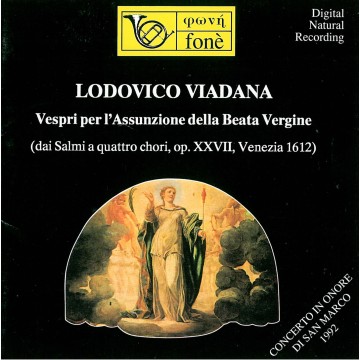
TRACKLIST
- Toccata Prima 2.41
- Deus in adjutorium / Domine ad adjuvandum 2.25
- Assumpta est Maria in coelum 3.25
- Dixit Dominus 5.39
- Assumpta est Maria in coelum 0.35
- Maria Virgo assumpta est 0.47
- Laudate pueri 7.24
- Recitar Primo 4.06
- In odorem unguentorum 0.35
- Laetatus sum 7.45
- In odorem unguentorum 0.35
- Benedicta filia tua 0.40
- Nisi Dominus 6.04
- Fuga del nono tono 2.26
- Pulchra es et decora 0.43
- Lauda Ierusalem 5.04
- Pulchra es et decora 0.41
- Ave maris stella 2.16
- Plaudat nunc organis Maria 2.42
- Magnificat 10.33
- Canzon (IV) 2.20
- Salve Regina 3.32
Recorded by Giulio Cesare Ricciin theChurch ofSt.Mark, Rovereto, on the 2nd and 3rd of May 1992 for the fourth edition in a series of SpiritualConcerts in the Lagarina Valley, entitled "A concert to honour St. Mark".
With a concert held in the church of St. Peter the Apostle in the Northern Italian town of Viadana on May 1st, 1992, followed by this recording on CD of Lodovico Viadana's music, a wish first expressed by the musicologist Federico Mompellio finally came true. In the preface to his book "Lodovico Viadana: a composer spanning two eras", published by Olschki, he looked forward to the revival and performance of the composer's works in actual "concreteness of sound", as he put it. This was back in the 1960s, a period which saw the happy convergence of interests by the local administration, encouraged by the late Marino Boni, together with a commonly expressed desire to throw light on the figure of 'Friar Lodovico'. As well as publishing the above-mentioned study, Mompellio also directed all his energies towards establishing the Lodovico Viadana musical source library. This collection has gathered together on microfilm the composer's entire output, as well as providing a complete modern edition of his opera omnia, painstakingly transcribed by the musicologist's fellow collaborators. Few would doubt that the settings of the Salmi a quattro choir, or "Psalms for Four Choirs, to be sung and played on High Feast Days throughout the liturgical year" are Viadana's masterpiece. The highly interesting preface, "How to orchestrate the Psalms for four choirs", on the reverse side of the organ bass title page, is one of the earliest existing texts in which a composer provides a wealth of details as to the most suitable way of performing his music. It is this, without any doubt, that provides the essential key enabling us to approach the true spirit of the work. The need to involve such large numbers of singers and players has obviously been an almost insurmountable obstacle to the performing of this work over the years. As it happens, we have no news of performances which have taken place in modern times. This recording, following in the wake of two live concerts in the Northern Italian towns of Viadana and Rovereto, appears at a time when the Italian early music scene is some way behind other European countries such as Germany, France and Holland, where agreat deal of timeand keen effort is being dedicated to the research and rediscovery of little-known works by composers from the past. The impressive sonorous structure of these liturgical compositions, which are particularly festive and grandiose in character, had other exponents in a wide area which looked to St. Mark’s Basilica in Venice for its inspiration. The high priests of this style were first and foremost Giovanni Gabriel with his Sacrae Symphonie, I (1597), then Giovanni Bassano (Mottetti per Concerti Ecclesiastici for 5, 6, 7, 8and 12parts with organ continuo, 1588-1589), Benedetto Pallavicino (Sacrae Dei Laudes, 1605), Giovanni Croce (Sacrae Cantilene Concertate for 3,5 and 6 voices, with Full Choir parts for four voices and Organ Bass, 1610) and finally,
Claudio Monteverdi with his Vespers of the Blessed Virgin, 1610.
Luigi Meneghini


 Native Dsd
 Hd Tracks
 High Res Audio