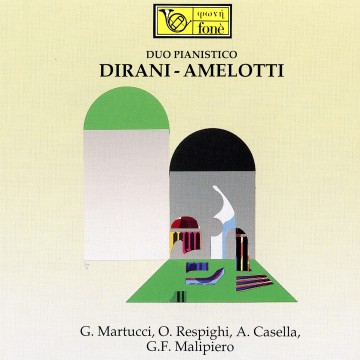
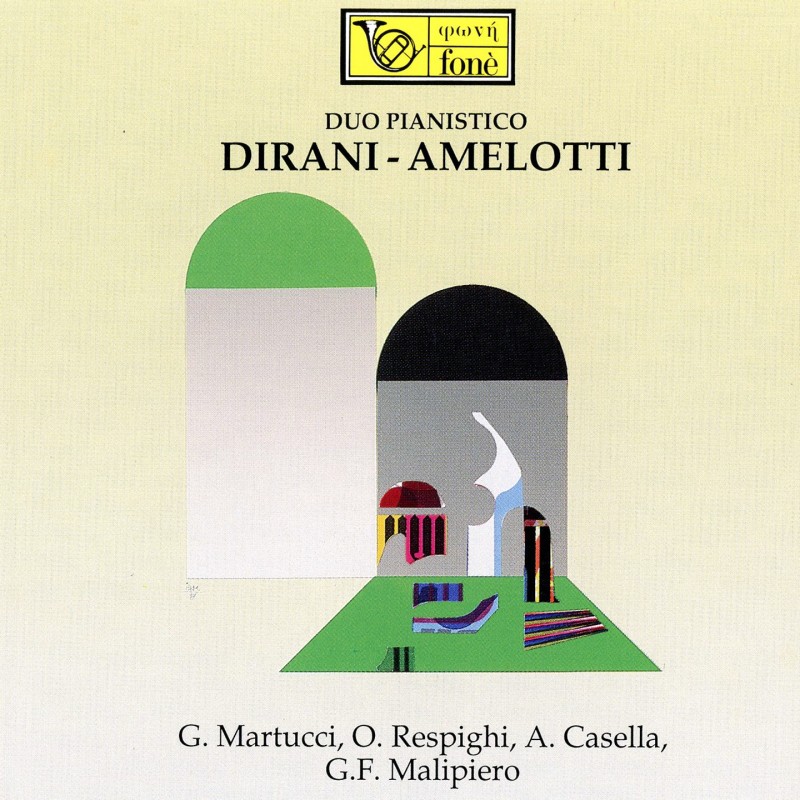
G. Martucci (1856-1909): Pensieri sull'opera "Un ballo in maschera" Op.8 (1874) [9'16"]
O. Respighi (1879-1936): Sei Piccoli Pezzi (1926)
Romanza [1'22"]
Canto di caccia siciliano [1'11"]
Canzone armena [1'48"]
Natale, Natale! [1'35"]
Cantilena Scozzese [1'36"]
Piccoli Highlanders [2'36"]
A. Casella (1882-1947): Pupazzetti Op. 27 (1915)
Marcetta [36"]
Berceuse [1'48"]
Serenata [1'13"]
Notturnino [2'24"]
Polca [1'31"]
A. Casella (1882-1947): Pagine di guerra Op. 25 (4 “films” musicali, 1915)
Nel Belgio: sfilata di artiglieria pesante tedesca [1'59"]
In Francia: davanti alle rovine della cattedrale di Reims [2'20"]
In Russia: carica di cavalleria cosacca [1'15"]
In Alsazia: croci di legno [2'49"]
G.F. Malipiero (1882-1973): Pause del silenzio (1917) [14'30'']
Durata 49'48''
RECORDING DATA
Recorded at Teatro Pedrini – Brisighella (RA)
Recording date 13-17 settembre 1990
Recording supervisor & Sound engineer Giulio Cesare Ricci
Tube microphone Neumann U-47, U-49
Mixing console Bè Yamamura 4.0
Analogue tape recorder Studer J37 two tracks
Digital tape recorder Sony PCM
Cables Van Den Hul
Music consultant Giacomo Fornari
Text Lia Gabri
ITALIAN PIANO FOUR HAND COMPOSERS
Giuseppe Martucci (Capua, 1856 -Napoli, 1909) leading composer in the Italian instrumental scene of the second half of the 19th century, isfamous for his Germanophile attitude while Italy, home of Opera, was invaded by realistic melodrama. “Pensieri sull’opera 'Un ballo in Maschera”, op.8, written about 1874, represents the sole piece of his repertoire for four hand piano. The art of transcription is one of the peculiarities of Martucci’s style (e.g. the famous “Pastorale” by Sammartini). As he was a very close friend of Liszt, it is not strange that the Italian composer dedicated himself to paraphrase a work by another author, which is typical of the 19th century. As he was one of Wagner’s Italian promoters, it is quite surprising that he chose the vitality of a Verdi piece for his work. The op.8 demonstrates that in Martucci’s work the Italian instrumental Renaissance did not spring out of snobbish detachment from melodramatic tradition. “Sei piccoli pezzi” (or “Sei pezzi per bambini”), composed in 1926, is the sole four hand piano composition by Ottorino Respighi (Bologna, 1879 -Roma 1936). In these short and graceful pages, Respighi seems to be choosing the romanticism of Schumann “Album fur die Jugend”, despite the influence that Gregorian Chant, Italian Baroque, Rimskij~Korsakov, Strauss and Debussy exerted on him. In these six pieces his vocation for exotic and folk music clearly stands out; they are therefore fine and harmonious melodies with fading reverberation and slightly irregular rhythm Respighi’s work goes from the narrative styleof “Romanza” to the folkloristic pattern of “Canto di caccia siciliano”, to the ancient, almost archaic fascination of “Canzone armena”, to the domestic atmosphere of “Natale, Natale!”, to the counterpointed mode of “Cantilena scozzese” and finally to the bagpipes playing the dance of the mountaneers of Northern Scotland in “Piccoli highlanders”. Two collections of four band piano compositions such as “pupazzetti” and “Pagine di Guerra”, both dated 1915, by Alfredo Casella (Torino 1883 -Roma 1947), reveal two different aspects of the stiff neo-classicism of the composer. “Pupazzetti” (Cinque pezzi facili-Five easy pieces) op. 27 will be rewritten in 1918 for nine instruments and, in 1920, for Orchestra. In these first five short pieces the sharply edged modernity of the music is in search of mainly grotesque effects: “Marcetta” (I) is undoubtedly farcical, “Serenata” (III) is a sort of caricature while “Polka” (V) recreates some rough, clownish comicality thanks to Stravinsky polytonality. The other compositions, marked by even numbers, are more thoughtful:in “Berceuse” (II), the author chooses a rhythm he particularly likes (6/8) which, according to some critics, means a sort of regress to childhood while “Notturno” shows something of the Bartok style in its hallucinated stillness. The title “Pagine di Guerra” op.25 is followed by the subtitle “Quattro films musicali” which is explained by Casella at the beginning of the score: “This title was chosen as these vague impressions had been suggested by cinema”. Here modern music, brought linguistically up to date by polytonal techniques, shows its aggressive and mournful side. In “NEL BELGIO: sfilata di artiglieria pesante tedesca” there is some Hindemith constructivism that is made of resounding notes and futurist toughness; in “IN FRANCIA: davanti alle rovine della cattedrale di Reims” thereare hard, poor, unpleasant chords; “IN RUSSIA: carica di cavalleria cosacca” is a modernised version of a traditional “typical piece” of the 19th century; · in the closing piece “IN ALSAZIA: croci di legno...” Casella goes back to his beloved Berceuse rhythm. The European fame of Gian Francesco Malipiero (Venezia, 1882 Treviso, 1973) started with the orchestra piece “Pause del silenzio” Prima serie, 7 impressioni sinfoniche (1917), here performed in the four hand piano version. This Prima serie, will be followed by a “seconda serie di 5 impressioni sinfoniche” (1926). Malipiero, far from expressionistic range, intolerant towards the principle of the development of one theme, but well disposed towards obsessive repetition. In this piece of music recreates a sortof Italian melodrama, joined with the harmonic inventions of Impressionism. There is a theme a mournful lullaby that is taken and adapted by Malipiero from “Passeggiata” in “Quadri di una esposizione” by Musorgskij, which links the different pieces and works as a frame for the whole composition, from beginning to end. It is as if it could hold together several aspects of the painful flowing of life such as the inconsolable poetry that the composer alternates with still and transparent sounds (I) wide spaced symphonic form (2), a· nocturne full of existentialist tedium (3), some vivid influence of Stravinsky “Petruska”(4), funereal atmosphere (5), some austere and archaic modes (6) and careless overlapping of different sorts of rhythm (7).
Franco Pulcini
(translation Andrea Ricci)

 Hd Tracks
 High Res Audio