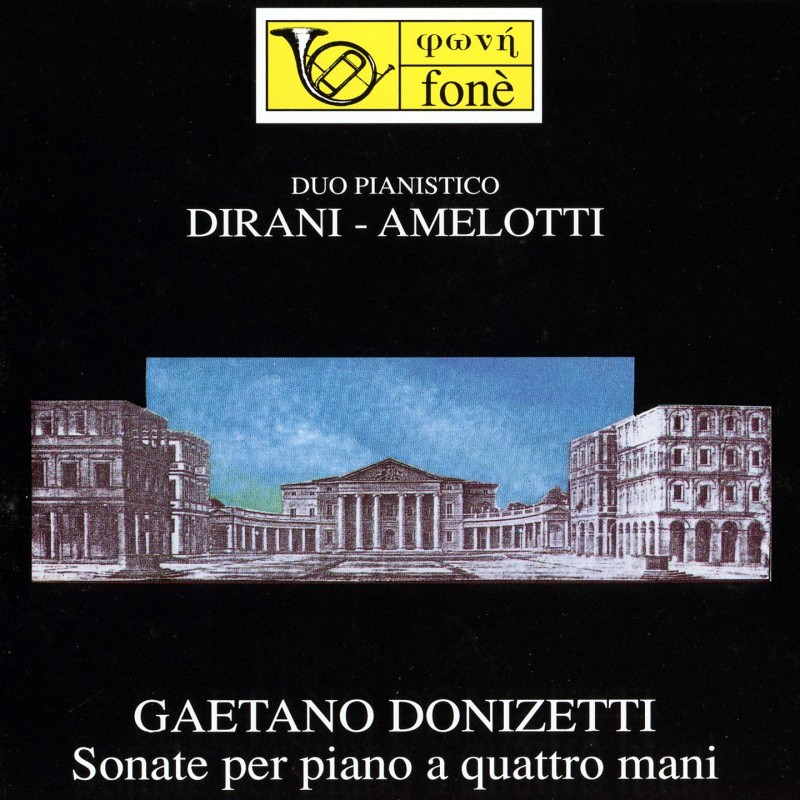
GAETANO DONIZETTI (1797-1848)
- Sonata in fa maggiore “La solita Suonata” presto (o) [6'15'']
- Sonata in si bemolle maggiore '”per Dolci e Donizetti” presto (o) [5'28'']
- Sonata in mi bemolle maggiore "L'inaspettata” allegro moderato (*) [8'18'']
- Sonata in fa maggiore “a quattro sanfe” larghetto -allegro brillante (o) [6'14'']
- Sonata in re maggiore allegro (*) [5'48'']
- Sonata in do maggiore (31-05-1819) allegro (*) [8'12'']
- Sonata in fa maggiore allegro -presto (*) [6'50'']
Durata 48'28" DDD
(*) 1.a parte P. Dirani -(o) 1.a parte F. Amelotti
RECORDING DATA
Recorded at Teatrino della Villa Aldrovandi Mazzacorati
Recording date Bologna, July 1990
Recording supervisor and sound engineer Giulio Cesare Ricci
General producer Giulio Cesare Ricci
English translation M. Degan – S. Hayes
Tube microphone Neumann U-47
Digital tape recorder Teac R-1
Un ringraziamento al Prof. Marco Fontanelli per la preziosa collaborazione; un ringraziamento particolare al Dott. Claudio Proietti per il saggio sulle Sonate per piano a quattro mani di Gaetano Donizetti.
GAETANO DONIZETTI (1797-1848)
SONATE PER PIANO A QUATTRO MANI
Talking about Italian music of the 19th century and a great part of the present century, it’s natural to think immediately of opera and theatre. The existence of a constant, somewhat submerged, but real instrumental tradition -which in the past century had greatly contributed to the creation of the myth of the Italian music civilization -has been ignored for years, even when the presence of “alternative” music was not disregarded. Submerged we said, and certainly suffering, but still alive -if this corresponds to the truth that authors like Piatti, Locatelli, Boccherini, Viotti, Cambini, Clementi, Raimondi, Radicati were forced to live and work abroad for a long time, and that (apart from the extreme but isolated case of Paganini) the instrumental composers of the following generations, such as Bazzini or Golinelli, are still waiting for a concrete recognition. It was so alive that it provided a fertile “humus” for the great melodramatises, many of whom left to us relevant and meaningful instrumental and chamber music. Apart from the sensational “silence” of Rossini after the composition of Guillame Tell in 1829, which was apparently related to the theatre only, fortunately today nobody still pretends to ignore the prolific production of symphonies, sonatas and sacred music by authors such as Bellini, Cherubini, Mercadante and Paisiello. Concerning Donizetti, the discovery and revaluation of his extremely rich instrumental works has been stimulated and promoted by the “Donizetti Renaissance”, an association that has now existed for decades, to which we also owe the discovery of a major part of his work for the theatre, that time had forgotten. In the specific case of this composer from Bergamo much has been said and written, particularly about the determining influence that his first teacher, Johann Simon Mayr, had in the formation of Donizetti’s prolific instrumental works (as a matter of fact his instrumental production was as prolific as that for the theatre, since in few years Donizetti wrote some 16 symphonies, 5 concertos for different instruments, 18 quartets,1 sextect, several quintets, some trios, and an incredible amount of duets and solo pieces). Certainly these solid foundations learned from Mayr in his native land -Baviera -were the basis of his didactic activities; however, apart from his early emigration to Italy to study in Bergamo and Venice, it is worth mentioning that many of Donizetti’s works can be ascribed to a later period of formation in Bologna under Father Mattei, between 1815 and 1817. They are therefore part of an openly Italian tradition which had absorbed the formal patterns of the sonata from the other part of the Alps and were used with wisdom and imagination. This collection of Sonatas for four hands piano gives genuine evidence of this. Although Donizetti was a renowned virtuoso of the piano, it is clear in these keyboard compositions that he is not using the piano for his pianistic experiments, but as a workshop, since he considered it as an orchestra in miniature. It is perhaps worth noting, incidentally, that music for four hands was throughout 19th century, the most popular means to play orchestral music at home -through its transcriptions-since the piano was flexible and relatively easy to play. These Sonatas appear in short as symphonies from operas written on four pentagrams instead of one score, and it is obvious, from the very first listening with today’s awareness, that they were going to be developed later. All of them have only one movement, some 200 bars long, written according to the simple sonata form, in which the repeat is often shortened. The themes are always characterized by a sharp feature which is typically theatrical; sometimes the usual contraposition of two themes is enriched with a third idea, as frequently happens in Beethoven. Some of these Sonatas have somewhat mysterious titles, which show the lively andwitty spirit the author attaches to them. The Sonata in F major (“La solita Suonata”) starts with a lively affirmation of the key and from a quick movement of scales in semiquavers which supply the basic rhythm of the piece, at least until the introduction of the second theme, as supporter both to the sharp rhythmical patterns and to the frantic contrapuntal game between dynamic sections. After a linear development and a repeat deprived of its first thematic episode, the “coda” fades on a repeated game of questions and answers more and more rarified until the end. So Donizetti annotated: “This way end all things in this world”. The Sonata in B flat major (“Per Dolci e Donizetti”) is much more homogeneous, with its regular stressing of fluid semiquavers, which follow a design that soon changes into surprising harmonic movements and gives form to the cheerful and openly operatic second theme in F major. The Sonata in E flat major (“L’inaspettata”) is based on a propositional theme, built on a dotted rhythm and an answer in quatraines of semiquavers, which is suspended and repeated before setting out, at the eighth bar, for a true melodic expansion. In this composition, too, the spatial game of questions and answers between treble and bass indicates the orchestral potential, even though the movement of the parts eventually becomes a little mechanical. The Sonata in F major (“Sonata a quattro sanfe”) repeats a commonplace of the “opera symphony”: a slow introduction pervaded by the suspence of expectation, followed by a sudden shift to a rapid passage. Then there is a brilliant “Allegro Vivace” in 6/8 time which exploits, alternating them, its fluency and its lively sense of dance. The Sonata in D major, among those here included, is nearest to perhaps the best models of compositions f or f our hands piano -i.e. Schubert’s ones (which Donizetti’s surely didn’t know). The game betweenthe two parts and the typical piano patterns contribute to this sensation, together which the melodic inflections of the second theme which has much more intimate cantability, sensitive to the harmonic colour. Also in the code a typical operatic element is present, that is the unexpected intrusion of repeated triplets, and even the peremptory final is very theatrical. The Sonata in C major is one of the finest affirmations of this key, from the emphatic and redundant beginning, with the bouncing incisiveness of the second theme, to the prolongued and learned preparation of the third idea and finally with its constant permutations, which can be compared to the wandering indecision of an anxious character. The Sonata in F major presents a clear and dramatic contrast between the introduction “Allegro” in 4/4 time, containing a vague and affected tension -and the “Presto” in 3/4 time, in F minor, on which the real Sonata is based. It’s a peremptory piece, with a somewhat sparkling incisiveness, touching, in some moments -especially in the episode of the second theme -, the tone of a “clementino patetismo” (pathetic feeling), but which towards the end changes progressively its dramatic mood until the reassuring luminous atmosphere of the finale.
CLAUDIO PROIETTI

 Hd Tracks
 High Res Audio