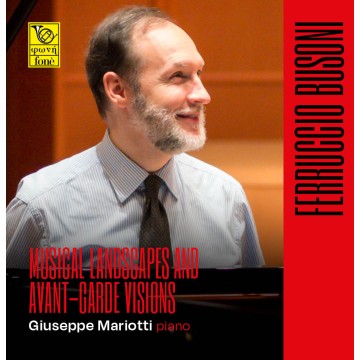
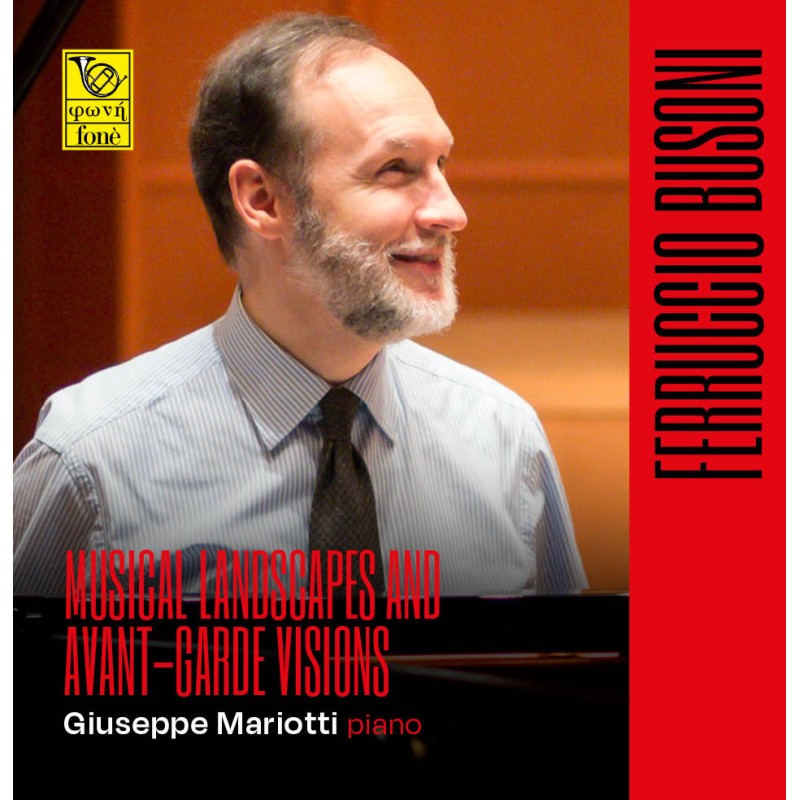
Musical Landscapes and Avant-Garde Visions
An album blending classical tradition and experimentation: Ferruccio Busoni’s Musical Landscapes and Avant-Garde Visions in high-resolution audio.
Suite Campestre Op. 18 Kind. 81 (1878)
1 Canzone Villereccia del Mattino
2 La Caccia
3 L‘Orgia
4 II ritorno
5 Preghiera della sera
6 Fantasia nach Johann Sebastian Bach Kind. 253 (1909)
Indianisches Tagebuch Kind. 267 (1915)
7 Allegretto affettuoso, un poco agitato
8 Vivace
9 Andante
10 Maestoso ma andando
11 Sonatina seconda Kind. 259 (1912)
12 Vierte Ballet-Szene Op. 33a Kind. 238 (1892)
13 Sonatina in diem nativitatis Christi MCMXVII Kind. 274 (1917)
Drei Albumblätter Kind. 289 (1917 - 1921)
14 (Zürich) Andantino sostenuto
15 (Roma) Andante
16 (Berlin) In der Art eines Choralvorspiels. Sostenuto religioso
Ferruccio Busoni stands as a towering figure in the musical landscape of the turn of the century. His unbridled activity as a man and musician shaped his entire life, and his universal genius allowed him to reach absolute and, unfortunately often misunderstood, artistic heights. His impressive virtuosity never seemed imposing, and his avant-garde and highly original musical vision became legendary. Beloved by audiences since his youth, he often baffled critics. His later compositions in particular rank among the most important and brilliant of his time: his works for piano and especially those for orchestra and opera influenced an entire generation of musicians. He vehemently advocated for the performance and publication of works and critical essays of then-contemporary music. Arnold Schoenberg, for example, who succeeded him as teacher of the composition class at the Berlin Academy of Music, found great support in his work through Busoni. Busoni's literary education and keen intellect allowed him to write the text of his operas himself, to correspond with the greatest figures of his time, and to publish some essential works, of which the most significant is the Entwurf einer neuen Ästhetik der Tonkunst (Sketch of a New Aesthetic of Music) (1907), in which he describes pioneering intuitions, such as the dodecaphonic system, microtonality, and new notation systems, and even makes predictions about electronic music. He was the inspirer of a new piano construction, namely the Imperial model of the Viennese piano manufacturer Bösendorfer, which was also used for this recording. The character pieces of the Suite Campestre, which Busoni composed at the age of twelve, clearly take Schumann's Album für die Jugend (Album for the Young) as their model. They reflect the late Romantic idealization of rural life. In the Preghiera della sera (Evening Prayer) a certain mystical atmosphere and a polyphonic compositional style, for which Bach served as a model, are noticeable. These elements are also frequently found in Busoni's late works. The Fantasia nach (after) Johann Sebastian Bach was composed in memory of his father Ferdinando. Three organ compositions by Bach serve as the basis of the piece, which consists half of this original material. The emotional intensification of the work is expressed by the constant alternation of major and minor sections. Remarkable is the change from the prevailing sadness at the beginning to the reconciliation at the end. The score bears the significant words PAX EI! on the last page. For Busoni, the term "Sonatina" refers to the form and length of the piece, not to its difficulty level. The intimate character of the Sonatinas and the return to simple and clear compositional schemes (which reflect the ideal form of "Young Classicism") form a contrast to the previous works. The Sonatina seconda is an exception in this respect, in that it represents an attempt, in the spirit of Schoenberg's model, to make the piece atonal. New elements, such as the absence of bar lines or a changed way of using accidentals, appear here for the first time. The changeable, chaotic, and often brutal character of the piece reflects the mood of the painting "Growing City" by Umberto Boccioni, which Busoni owned and which served as inspiration for this sonatina. The calm, serene simplicity of the Sonatina in diem nativitatis Christi fully embodies the model of "Young Classicism". The Christmas bells, the chorales, the mystical atmosphere, as well as the pipe music, are all woven together into a fine polyphonic fabric that has an archaic and enchanting effect. During his tours, Busoni visited the New World several times, which made a deep impression on him. The songs and melodies of the Native Americans inspired him to write a fantasy for piano and orchestra, from which he composed the Suite Indianisches Tagebuch (Indian Diary). All themes are faithful transcriptions of Native American motifs, which were reworked according to the rules of European music, but also include the typical pentatonic and esatonic tonalities of these peoples. The Fourth Ballet Scene of 1892 is almost an homage to Johann Strauss and his waltzes, quite in the style of the brilliant salon-style playing that was very much in vogue at the time. The last compositions have a close relationship to Busoni's unfinished opera, Doktor Faust, whose themes were often developed or brought to maturity in the piano works. The thoughtful and melancholic Drei Albumblätter (Three Album Leaves) reflect the composer's state of mind after the horrors of the First World War. The first piece, icy and crystal-clear, unfolds refined harmonies and a fine, intimate rhythmic swing. The second, a fugato, shows an extremely abstract and mysterious side of Busoni, while the third returns to Bachian sounds with the chorale "Christ lag in Todesbanden". Giuseppe Mariotti

 Reference Music Store